|
|
|
KS2/Y6
Clown
Picture-books don't have to be restricted to the KS1 classroom. Alongside
more challenging reading material they offer older children a chance to develop
their imaginations and they provide valuable continuity with earlier learning.
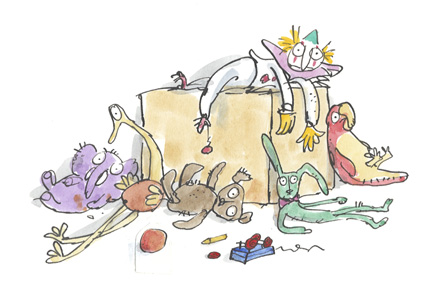
Quentin's only picture-book without any text, Clown, tells the story of
a discarded toy clown and his adventures in the big city which end happily.
Books without words
Story-making and telling – a group activity
You will need:
Several copies of Clown (one per group)
Digital cameras
Selection of toys with human attributes (avoid commercial characters which come
with their own ready-made stories)
Clown is a story that is probably best discovered on an individual level where
children or adults can look at the pictures and decide things for themselves.
Where does Clown come from? Who are the girl and the baby?
In the story is there a difference between the way that children and adults respond
to Clown?
However there are many ways Clown can be used in the primary curriculum particularly
with older children in KS2.
An obvious teacher-led response to Clown might be to get children to write a
text to the pictures but is this really a valuable exercise for a book that needs
no written words? The following activity emphasises the importance of images
and the value of spoken language as a prerequisite for writing.
- Groups look at Clown and discuss their interpretations of the story.
- Explain to the children that they're going to make their own book
without words using photographs. They will go on to tell the story in their
book to groups of younger children in the school. They will be using the
school and the immediate outside environment as a setting for their stories.
- Groups select their toy and plan their story, perhaps storyboarding it
(you may decide to limit the number of frames). Encourage the children to
think about the audience – they should discuss the structure of the
story and how to keep it really simple. They may also need to consider issues
such as whether their audience will expect a happy resolution?
- Children take their photographs, upload them onto the computer and print
them.
- Photographs can be put into handmade or commercially-produced books.
- Individual children in the group can use the finished book to tell their
story to a small group of younger children.
Curriculum links: ICT, literacy: speaking and listening, art and design,
design and technology, PSHE
Picture captions
If you really would prefer to use Clown as the basis for a writing exercise
you could encourage the children to write a very simple text, perhaps limiting
the children to five words for each page.
|
|
|

















