|
|
Who is Mrs Tredegar?
Writing activities
- Read the story to the children, reminding them that it’s
both written and illustrated by Quentin Blake and that the
pictures will provide them with information that’s as
valuable as the text.
- Discuss the character of Mrs Tredegar looking for textual
and visual clues to back up ideas. For example, she’s
rich because she wears ‘posh clothes’, has a big
garden and a gardener to attend it.
- Use a range of questions to promote discussion about her
story, for example, why does she have an imaginary ship in
her garden? Who is the man in uniform in the photo? Does Mrs
Tredegar believe that the ship is real? Why is she always asking
what the Captain would have done? What is the role of the Bosun
and how much does he believe in the story? How does Mrs
Tredegar feel about the fact that the ship will disappear one
day?
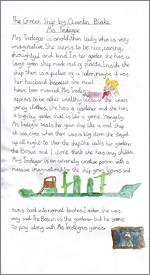
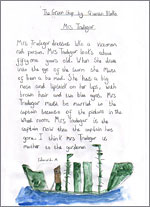
- Ask the children to write their own character descriptions
of Mrs Tredegar.
These are examples of work produced by a mixed-ability Y5 class.
- An alternative focus might be to look at settings and
the historical context of the story – why are the children
staying with their aunt? Could they be evacuees? Mrs Tredegar
and the Bosun are wearing clothes from another age. They play
old-fashioned games such as deck quoits and they’re drinking
lime juice and eating madeira cake and cucumber sandwiches.
Curriculum links: literacy (speaking and listening, reading, writing),
art and design, PSHE, history, geography
|
|
 |

















